DarkMoon research series·D. Open source & licence·Article 19 of 23·All 23 articles
Not legal advice. The LICENSE text applies. DarkMoon's LICENSING.md and its contributor agreements are drafts under review by counsel at the time of writing.
Introduction
The previous article in this series, Why DarkMoon Community Is Moving from GPLv3 to AGPLv3, described the licence change and its exact status. This one looks at the model around it: an open-source edition under the AGPL-3.0, DarkMoon Community, and a separate commercial product, DarkMoon Pro. Such models are common and also contested. We try to state plainly what each party gains and what it gives up, without presenting the model as free of cost for anyone.
Problem
Three questions come up repeatedly about AGPL-plus-commercial models:
- Does the AGPL push users towards the paid edition? It is sometimes described that way.
- What does a contributor give, and to whom? If the company can sell what the community writes, the exchange must be explicit.
- Where is the line between editions, and is the open edition a crippled demo?
Methodology
We answer from three public sources only: the licence texts, DarkMoon's LICENSING.md, and the code and research records of the Community edition. Where something is a draft or a plan, we say so.
What the AGPL requires, and what it does not
The AGPL-3.0 gives everyone the rights to run, study, modify and share the software. It adds obligations in two cases: when you distribute the program, and when you let users interact remotely over a network with a modified version (section 13). In both cases the obligation is the same: make the corresponding source available under the AGPL-3.0.
It does not:
- restrict who may use the software or for what purpose, including commercial use at any scale;
- require payment;
- require buying DarkMoon Pro, or any other product.
A company can use DarkMoon Community indefinitely, commercially, as long as it respects the licence. DarkMoon Pro is bought for its own features and support, not as a way out of the AGPL.
Where the edition boundary sits in the code
The boundary is documented in the attack-paths research repository and visible in the public code. Both editions share the attack-path schema and engine modules; Community forces off the server-side execution ledger and withholds agent-written evidence text from the engine.
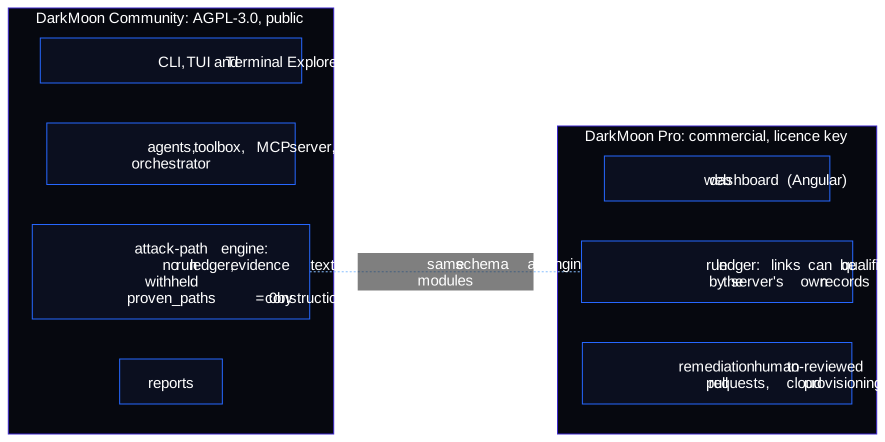
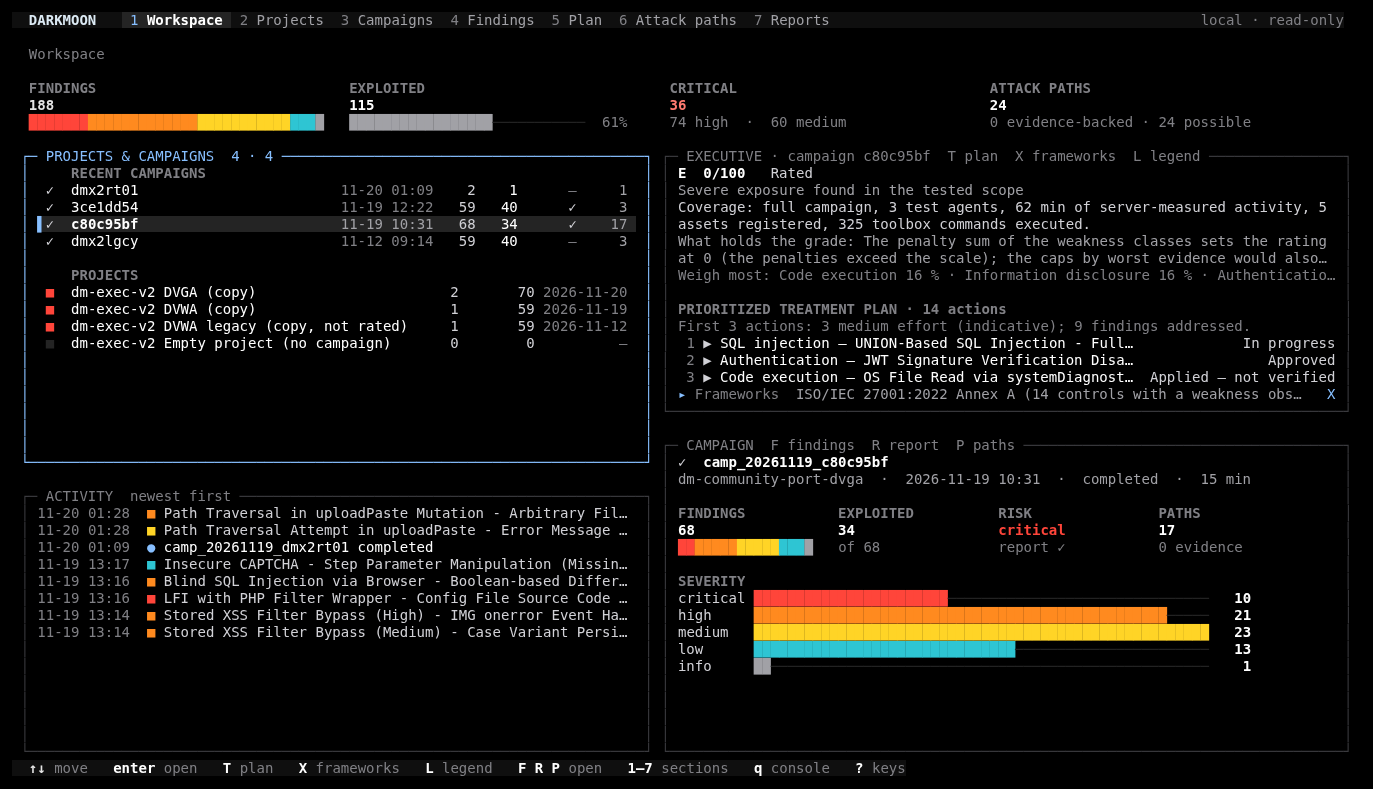
A design consequence worth stating: Community never labels an attack path as evidence-backed, because it lacks the server-side records that would justify it. The open edition gives a weaker claim, not a fake one (VERIFIED, ADR-A11; real DVGA campaign on Community: 68 findings, 17 paths, 0 proven, EXP-060).
Real results: the tradeoffs, party by party
| Party | Gains | Gives up or accepts |
|---|---|---|
| User running DarkMoon for itself | full source, free use, no obligation when it only runs the software | nothing new compared with the GPL |
| Service operator (MSSP, consultant) with a modified DarkMoon that clients use remotely | the right to build a service on the code | must offer those clients the source of the modified version; cannot keep improvements private while serving them over the network |
| Service operator with an unmodified DarkMoon | same as above | keep the licence notices; no further source obligation beyond what the program already offers |
| Contributor | code stays open in Community; ASC commits (in the draft CLA) that every contribution it includes in the open-source edition stays available under an open-source licence | once the CLA is in force, grants ASC the right to also offer the code under commercial licences; this asymmetry is the core of the deal |
| ASC (publisher) | network reciprocity from competitors who host modified forks; the option to sell commercial licences for code it holds rights to | some organisations avoid AGPL code by policy; contributions need a CLA to be reusable commercially; earlier outside contributions are excluded from commercial licences unless their authors agree (LICENSING.md) |
| Organisation that wants to embed DarkMoon without AGPL obligations | may ask ASC for a commercial licence, an option, never an obligation | pays for that licence; it covers only code ASC holds rights to |
Two points deserve emphasis.
The CLA asymmetry is real. Under a CLA, the company can do something with contributions that contributors cannot do with the company's code: relicense it commercially. DarkMoon's draft answers with a commitment that included contributions stay available as open source. Whether that balance is acceptable is each contributor's decision. Today the question is open in practice: the CLA and the Corporate CLA are drafts and cannot be signed yet, and new contributions are accepted under the AGPL-3.0 only.
Earlier code is unaffected. Releases up to v1.6.0 and contributions made before the switch remain GPL-3.0. Nobody who relied on the GPL loses anything.
Limits
- Not legal advice. Whether a deployment is « remote network interaction » with a modified version depends on facts. Example: a provider that runs a modified DarkMoon itself and gives clients only reports should check its situation with counsel; this article cannot decide it.
- Drafts. LICENSING.md, the CLA and the Corporate CLA may change after legal review; no AGPL release has been tagged yet.
- Third-party components keep their own licences. The toolbox bundles separate programs under various licences (some with their own terms for commercial use), and the OpenCode fork stays under its MIT licence. The AGPL of DarkMoon's own code does not change them.
- Trademarks are separate. Forks and services built on the code must not present themselves as the official DarkMoon product.
- The research repository linked here is technical context, not legal authority. It documents the edition boundary in code; it does not interpret the licence.
- No measurement. We have no data on how the change affects contributions, adoption or forks. Any such effect is not measured.
Figures
- Figure 1 (Mermaid): edition boundary, derived from a diagram checked against Community commit
10eaab0in the research repository.
Sources (verified)
- Free Software Foundation. GNU Affero General Public License, version 3 (see section 13). https://www.gnu.org/licenses/agpl-3.0.html
- Free Software Foundation. GNU General Public License, version 3. https://www.gnu.org/licenses/gpl-3.0.html
- Open Source Initiative. GNU Affero General Public License version 3. https://opensource.org/license/agpl-v3
- SPDX.
AGPL-3.0-only. https://spdx.org/licenses/AGPL-3.0-only.html - ASCIT31/Dark-Moon. LICENSING.md and CLA.md (drafts).
All pages fetched on 2026-11-20.
Research, source code & reproducibility
- Research repository (technical context): ASCIT31/darkmoon-attack-paths-research, in particular diagrams/05-community-vs-pro, ADR-A11 and EXP-060.
- Source code: ASCIT31/Dark-Moon; the edition switch is implemented in
mcp/api/attack_paths_local.pyandmcp/api/feature_flags.py. Terminal Explorer:conf/plugins/darkmoon-explorer. - Documentation: https://docs.dark-moon.org
- References: the licence texts above.
- Reproducible checks: the claim « Community never proves a path » can be checked in code (the flags forced off in
feature_flags.py, the evidence-text replacement inattack_paths_local.py) and on any Community campaign in the Paths tab of/explore.
Related reading: Why DarkMoon Community Is Moving from GPLv3 to AGPLv3 · Building DarkMoon in the Open: Research, Benchmarks, Failures and Reproducibility · Declared vs Proven Attack Paths: A Practical Evidence Model
If a part of this model is unclear or seems unfair to you, say so in an issue on ASCIT31/Dark-Moon. For your own situation, ask your own lawyer.
See the proof, not just the write-up: the Pro remediation benchmark (fixes retested against the exploit) · how Darkmoon compares to other AI pentest tools.
← All articles