DarkMoon research series·A. Architecture & attack paths·Article 6 of 23·All 23 articles
Introduction
"Proven" is the most dangerous word in a security report. Once a reader sees "proven attack path", they stop asking how it was proven, and they prioritise remediation on that basis.
DarkMoon learned this the hard way: the word changed meaning several times in a few weeks of November 2026, and older reports are only readable with the definition in force at their date. The result is an explicit, small evidence model that any team linking findings can adopt or criticise. It is documented in the causality and evidence chapter and the provenance chapter of the research repository.
The problem
A link between two findings can come from three very different places:
- someone says B used A's result (an agent or an operator);
- a fixed rule finds a pattern in the evidence (for instance, a response containing a system account file);
- the system recorded a value leaving A's execution and entering B's.
If all three are drawn with the same arrow and counted in the same "proven" total, the total is meaningless. Worse, it tends to grow with whichever source is least reliable.
Methodology
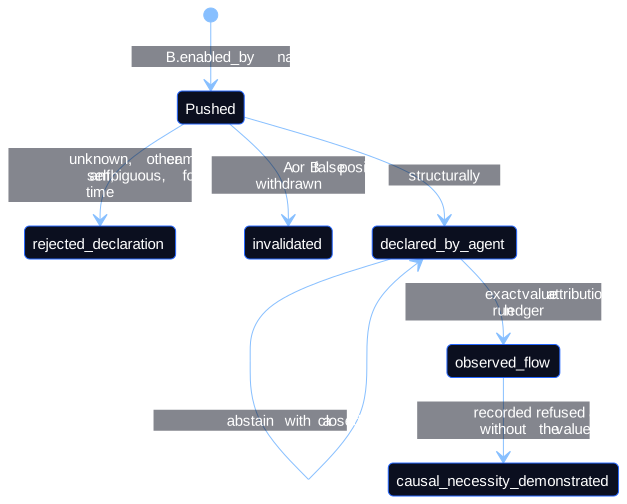
The model has two layers: a state for each link, and a level for each path computed from its links. It is implemented in the open-source engine at the documented commit; the description below follows the code.
Link states
| State | Server label (verbatim) | What it asserts |
|---|---|---|
declared_by_agent | "Declared by the agent · not verified by the server" | an agent says B used A's result |
observed_flow | "Observed flow — the server recorded the value flowing from A's execution to B's successful execution" | a recorded flow, not necessity |
causal_necessity_demonstrated | "Necessity demonstrated — refused without the value, accepted with it, both recorded" | flow plus a recorded negative control |
Two exit states exist: rejected_declaration (unknown, self, other campaign, ambiguous, forward in time) and invalidated (A or B marked false positive or withdrawn).
Conditions for observed_flow
A declared link A → B is promoted only when all of these hold:
- A and B are in the same run, both live, not duplicates.
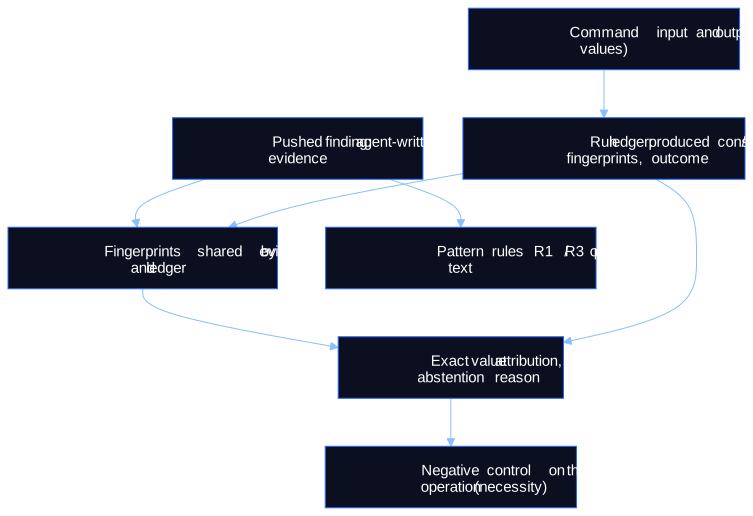
- A value fingerprint is shared in full by A's and B's own pushed evidence.
- One execution
e_aproduced it;e_ais unique in the run, and the value was never presented before it. - A successful execution
e_bconsumed it frome_a. Success needs an HTTP 2xx or an exit 0 with the expected output; exit 0 alone does not count. e_aprecedese_b, and both precede their finding's push.- No other live finding presenting the value was pushed after
e_a.
Session identity may restrict a match, never create one. Necessity additionally requires a recorded refused attempt without the value on the same operation key, in the same run, not compacted. In W3C PROV terms the check is e_b used v and v wasGeneratedBy e_a, accepted only when that lineage is unique and ordered (a mapping the repository labels HYPOTHESIS).
Path level: the weakest link
A path's level is the weakest link on it, in this order:
inferred < declared_by_agent < observed_flow < observed (rules R1/R3) < causal_necessity_demonstrated
The product then uses two words only. An Evidence-Backed Attack Path has every step supported by a server rule or qualification. Everything else, including any agent-declared step, any inferred step and any hypothesis, is a Possible Attack Path and is never ranked.
Operator declarations stay separate
Paths declared by an operator through the interface are admin-only, audited, kept outside the engine, and always worded "Declared by operator · not proven". They are never counted with engine paths, the treatment plan or the report.
Real results
- Real campaigns produce declared links, not observed ones. Declared links qualified by the server: 0 of 16 (c5 replay), 0 of 9 (c6 replay), 0 of 19 (c7), 0 of 19 (final lab run), 0 of 16 on DVGA in Community, which has no ledger. On the replays the reasons were 15
no_shared_valueand 1session_unknown(c5), and 9no_shared_value(c6). - Evidence-backed paths, where they exist, come from pattern rules, not declarations: 5 in 18 production campaigns, all from R3, and 1 in an offline recompute of a 20 November DVGA run (
VERIFIED/SIMULATEDas marked). - The reason is a privacy–provenance tension. The Privacy Gateway replaces secrets with placeholders before the model sees them, and agents additionally write
***where a credential was (8 of 11 pushes on c6, 16 of 39 on c5). 0 of 50 real pushes contained a non-host placeholder. Stronger model-side privacy and stronger server-side attribution compete for the same evidence; no design in the sources resolves this yet.
What "evidence-backed" does not mean
The repository lists six things the label does not assert. They are worth copying into any report template:
- Not causal. An observed flow says the value travelled, not that B needed it. No real campaign has produced a necessity record.
- Not independent of the agent's text for R1/R3. These rules match patterns inside the evidence the agent wrote into its push. Only the qualification step reads the independent ledger. Two product strings overstate this and are flagged for correction.
- Not complete. Assembly is bounded (depth 6, 100 chains, a time budget, simple paths only) and truncation is reported.
- Not "fixing X breaks the attack". Fix simulation is labelled "SIMULATION · not applied"; greedy top-k ranking had non-zero regret in 36.5 % of synthetic instances.
- Not reproduced. The engine does not re-execute a path.
- Not transferable across targets. Every precision figure comes from one target per run.
How the meaning of "proven" moved
| Period | "Proven path" meant | Status |
|---|---|---|
| up to 8 Nov 2026 | an R1/R2/R3 rule matched pushed evidence | SUPERSEDED for R2 |
| 11 Nov 2026 | an agent-declared final chain whose every step was exploited | SUPERSEDED |
| 17 Nov 2026 | "a step is proven by observation alone" (endpoint-bound flow) | SUPERSEDED |
| from 17 Nov 2026 | every link at least observed_flow, or R1/R3; worded "observed flow", never "causality" | current |
| from 19 Nov 2026 (Community) | never: proven_paths = 0 by construction | current |
Limits
- Whether
observed_flowcan ever trigger on real data with masked evidence isUNKNOWN. - The ledger observes commands, not the operating system: shell substitutions, cross-call shell variables and in-memory reuse are blind spots.
- The server cannot tell which sub-agent made a given tool call, so session identity cannot help attribution.
- Untested directions noted in the repository include verification before masking, keyed-hash commitments and in-vault comparison.
Figures
Scientific sources
- W3C. PROV-DM: The PROV Data Model. 2013. w3.org
- King, Chen. Backtracking intrusions. SOSP 2003. doi:10.1145/945445.945467
- Milajerdi et al. HOLMES: Real-Time APT Detection through Correlation of Suspicious Information Flows. IEEE S&P 2019. doi:10.1109/SP.2019.00026
- Inam et al. SoK: History is a Vast Early Warning System: Auditing the Provenance of System Intrusions. IEEE S&P 2023. doi:10.1109/SP46215.2023.10179405
- Pearl. Causality: Models, Reasoning, and Inference. 2009. doi:10.1017/CBO9780511803161
Research, source code & reproducibility
- Main research repository: ASCIT31/darkmoon-attack-paths-research, see docs/causal-model and docs/provenance
- Source code (open source): ASCIT31/Dark-Moon, link qualification in
edge_verifier.py - Benchmarks: ASCIT31/Darkmoon-Benchmarks (finding detection; separate from link evidence)
- Official documentation: docs.dark-moon.org
- Scientific references: literature review §3.2 and §3.4
- Reproducible experiments: EXP-047 (harness and real replay), EXP-052 (privacy end to end), EXP-056 (final real validation)
Related articles
- Agent-Native Attack Graphs: Why We Let AI Agents Declare Dependencies
- Attack Graphs, Knowledge Graphs and Causal Reasoning: What Is Actually Different?
- Measuring Attack-Path Reliability: Benchmarks, False Positives and Limitations
- Redesigning a Cybersecurity Dashboard Around Attack Paths
- Designing Explainable Security Graphs Without Misrepresenting Evidence
- Visualizing Attack Paths in ASCII and Unicode
The state names and labels above are the ones used by the open-source engine at the documented commit. If you export DarkMoon attack paths into your own tooling, keep the state with each link rather than flattening it into a single "proven" flag.
See the proof, not just the write-up: the Pro remediation benchmark (fixes retested against the exploit) · how Darkmoon compares to other AI pentest tools.
← All articles