DarkMoon research series·A. Architecture & attack paths·Article 4 of 23·All 23 articles
Introduction
Expert systems such as MYCIN, in the 1970s and 1980s, encoded specialist knowledge as rules, attached certainty to conclusions and could answer "why?" and "how?". They also taught the field two durable lessons: knowledge is expensive to acquire, and rule bases are brittle outside the cases they were written for.
LLM agents look like the opposite design: no explicit rules, broad competence, fluent explanations. DarkMoon's attack-path work ended up combining the two, and the record shows the classic lessons applying almost word for word. This article describes the resulting architecture as an engineering pattern. Details are in the expert-systems chapter of the research repository.
The problem
DarkMoon needed a component that decides whether a link between two findings is supported. Two pure designs were available.
- Pure symbolic: write rules that derive links from findings. Auditable, deterministic, but someone must supply the facts and the rules must cover the cases.
- Pure neural: let the LLM agent say which findings are linked. Broad coverage, almost free, but the claim is an opinion.
Both were tried, and both failed in recognisable ways.
Methodology
The repository groups every rule-based attempt, those still in the product and those rejected, and reads them against the expert-system and neuro-symbolic literature. The current design is then described from the code at the documented commit of the open-source edition.
What the symbolic attempts showed
| Attempt | What it did | Result | Label |
|---|---|---|---|
| Structured "chain data" fields | four typed pre/post fields the agent fills on each finding | filled 0/340 and 0/51 times; hidden from the schema | VERIFIED |
| Expert engine (rules arm vs observation-only arm) | rule-based linking on a live lab | 0 verified paths in both arms; contaminated, removed from evidence | SUPERSEDED |
| "Own command" attribution | a finding owns the observed command whose values it reuses | 5 families of false proven links, then 7 new false links | VERIFIED |
| MulVAL-like capability graph | CWE/CAPEC/ATT&CK pre/post-conditions | 10/78 edges correct (12.8 %) | SIMULATED |
| Rules on finding text | held-out replay on stored campaigns | 12 to 15 % held-out precision on the internal lab, 0/10 on Juice Shop | SIMULATED |
| ATT&CK tactic-order filter | plausibility of declared pairs | accepted 74 % of pairs and 10/10 false chains; warnings only | VERIFIED |
The repository reads these as the two classic failures (HYPOTHESIS, consistent with the literature): a knowledge-acquisition bottleneck (nobody filled the structured fields; specialists had never been instructed to) and brittleness outside the rule base (a capability graph produces many plausible but wrong edges).
What the neural side showed
Agents asked to declare links in one optional list (enabled_by) did fill it, with 0 invented ids on 50 findings, but strict precision against oracles was 0.6, 0.556 and 0.316 on three single runs. Fluent, cheap, and right roughly one to two times in three.
The resulting split
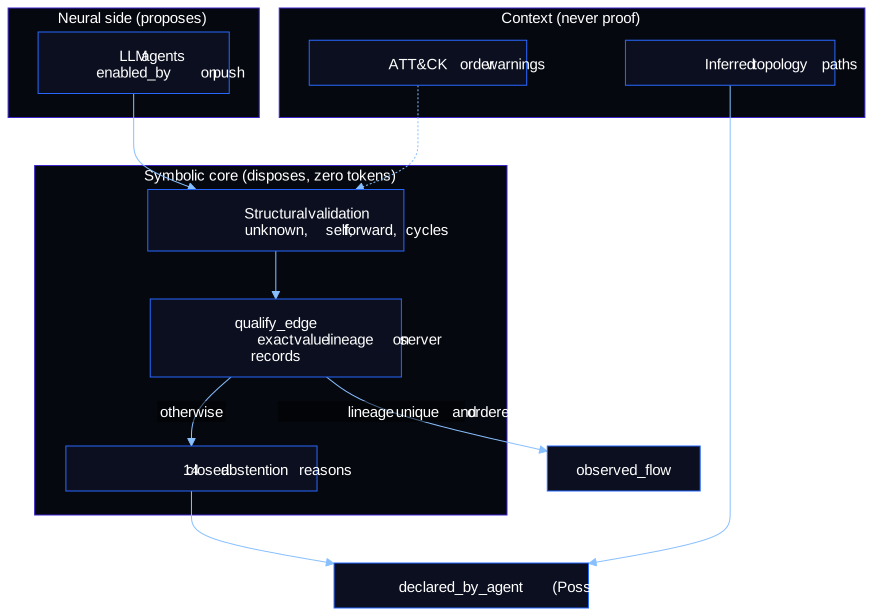
Architecture D keeps a minimal symbolic core behind the agents:
- The LLM proposes. Agents declare
enabled_byon the push they already make. The server stores each valid declaration asdeclared_by_agentand shows it at once as a Possible Attack Path. - One rule disposes.
edge_verifier.qualify_edgepromotes a link toobserved_flowonly when a value fingerprint is shared in full by both findings' evidence, was produced by a unique earlier execution, and was consumed by a later successful execution, in order, with no other finding presenting the value afterwards. A recorded refused attempt without the value is additionally needed forcausal_necessity_demonstrated. - Refusal is explained. Otherwise the link stays declared, with one of 14 closed abstention reasons (
no_shared_value,session_unknown,run_compacted,ambiguous_origin,exogenous_valueand others). Each link carries its state, reason and evidence references; references hold execution ids and a 12-character fingerprint prefix, never a value. - Structure stays context. Inferred topology paths and ATT&CK warnings remain visible, always labelled hypotheses, never ranked.
The rule can only promote, never invent an edge. Model output can never promote an edge. That is the symbolic guarantee; everything else is labelled by its source.
Real results
- On synthetic adversarial scenarios the core behaves as designed: 0 false promotions on 100 scenarios and 117 edges, recall 0.867, mutation score 95.2 % with 0 permissive survivors (EXP-049,
SIMULATED). An earlier mutation run had 38 permissive survivors; they were killed before release. - On real data the core abstains: 0 of 25 declared links qualified on the c5/c6 replay (15
no_shared_valueand 1session_unknownon c5; 9no_shared_valueon c6), 0 of 19 on c7, 0 of 19 on the final lab run (VERIFIED/SIMULATEDas marked in the repository). - The reason is structural: agents write
***where a credential was, and the Privacy Gateway tokenises secrets before the model sees them. 0 of 50 real pushes contained a non-host placeholder, so there was nothing exact to attribute.
In expert-system terms, the inference engine is sound on its test set and starved of facts in production.
Limits
- The "neuro-symbolic" description is a positioning, not a claim of novelty. Stevanovic and Wachter, ChainGraph and Intentest also pair an LLM with an explicit graph; none of these systems, DarkMoon included, has published a controlled measure of edge precision on real executed chains.
- The harness and its oracle were built by the same team; mutation testing shows the tests constrain the rules, not that the rules fit real data.
- Pattern rules R1 and R3, which still produce the rare Evidence-Backed paths, read the evidence text the agent wrote, not an independent capture. Two product strings overstate this and are flagged for correction.
- Whether
observed_flowcan ever trigger on real data with masked evidence isUNKNOWN.
Figures

Scientific sources
- Buchanan, Shortliffe (eds.). Rule-Based Expert Systems: The MYCIN Experiments of the Stanford Heuristic Programming Project. Addison-Wesley, 1984. (No DOI; verified indirectly through reviews indexed in Crossref, as recorded in the repository bibliography.)
- d'Avila Garcez, Lamb. Neurosymbolic AI: The 3rd Wave. 2020. arXiv:2012.05876
- Kautz. The Third AI Summer: AAAI Robert S. Engelmore Memorial Lecture. 2022. doi:10.1002/aaai.12036
- Ou, Govindavajhala, Appel. MulVAL: A Logic-based Network Security Analyzer. USENIX Security 2005. usenix.org
- Stevanovic, Wachter. Automating Attack Graph Construction for Agentic Pentesting. Towards Neuro-Symbolic Vulnerability Hunting. 2026. arXiv:2609.15523
- dos Santos Barbosa. Thinking in Graphs: Neo4j-Backed Exploit-Chain Reasoning for LLM Penetration-Testing Agents. 2026. arXiv:2610.20902
Research, source code & reproducibility
- Main research repository: ASCIT31/darkmoon-attack-paths-research, see docs/expert-systems and ADR-A09 architecture D
- Source code (open source): ASCIT31/Dark-Moon, the symbolic core in
edge_verifier.py - Benchmarks: ASCIT31/Darkmoon-Benchmarks (finding detection records)
- Official documentation: docs.dark-moon.org
- Scientific references: literature review §3.5
- Reproducible experiments: EXP-025 expert engine, EXP-040 rules on text, EXP-047 and EXP-049 harness and mutation testing
Related articles
- Agent-Native Attack Graphs: Why We Let AI Agents Declare Dependencies
- Attack Graphs, Knowledge Graphs and Causal Reasoning: What Is Actually Different?
- Why Our First Attack-Path Architectures Failed
- Declared vs Proven Attack Paths: A Practical Evidence Model
The verifier lives in a single file of the open-source repository. Reading it, and trying to make it promote an edge it should not, is the most useful review we can receive.
See the proof, not just the write-up: the Pro remediation benchmark (fixes retested against the exploit) · how Darkmoon compares to other AI pentest tools.
← All articles